
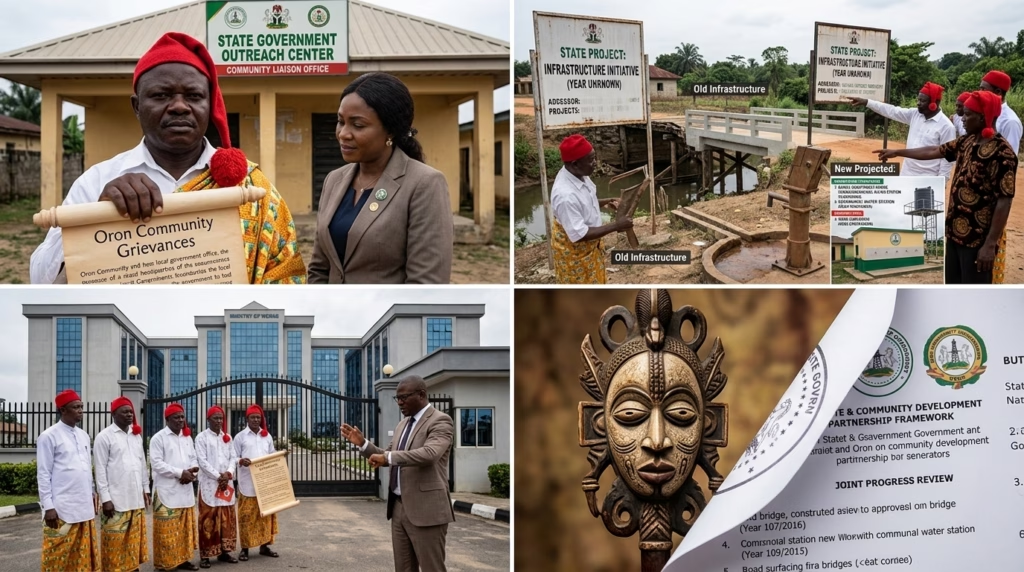
Why The Government Does Not Take the Oron People Seriously
By Ubong Rich — Founder, RichNation Global LTD
“The Oron People — Nigeria’s Most Ignored Goose That Lays The Golden Egg”
“They sit on the oil. They own the natural harbour. They have the coastline. They have the history. And they have been systematically sidelined, ignored and politically outmaneuvered for over 27 years in their own state. This is the full story of the Oron people and why the government does not take them seriously — and why that is a crime against Akwa Ibom itself.”
I want to talk about the Oron people today.
Not as a tribal Article. Not to start a fight between Ibibio and Oron or Annang and Oron.
I want to talk about them because understanding what has happened to Oron Nation is understanding what is wrong with Akwa Ibom State at the deepest level.
And until we face this honestly — no seaport will be built, no coastline will be developed, and no real progress will come to the southern part of our state.
FIRST, WHO ARE THE ORON PEOPLE AND WHY DO THEY MATTER
The Oron people occupy five local government areas in Akwa Ibom State — Oron, Mbo, Udung Uko, Urue Offong/Oruko and Okobo. Together they form what is called Oro Nation.
They are the third largest ethnic group in Akwa Ibom State after the Ibibio and the Annang.
They sit on some of the richest oil-producing territory in the entire Niger Delta. Oron has produced the highest oil quantum from Akwa Ibom State to the national purse — meaning the oil money that runs Akwa Ibom State government, that builds roads in Uyo, that funds salaries, that pays for government houses and government jets — much of it comes from underneath Oron land and Oron waters.
They also sit on something even more valuable for the future — a natural deep water harbour at Ibaka Bay with a non-dredged draft of 19 meters. That means large ocean vessels can dock there naturally without any artificial dredging.
In any country with serious governance, a people sitting on that combination of oil wealth and natural port infrastructure would be among the most developed and most politically powerful in their region.
In Akwa Ibom, they are among the most marginalized.
THE TRIPOD THAT WAS BROKEN
When Akwa Ibom State was created in 1987, the founding political arrangement was built on what is called the tripod — a power-sharing understanding between the three major ethnic groups.
Akwa Ibom’s politics thrived on rotating power among the three major ethnic groups — Ibibio, the majority spread across 19 councils, Annang, second with eight councils, and Oron, third with five councils.
This was not a perfect arrangement, but it was a workable one. It gave every major group a sense of belonging and a stake in the state’s progress.
Then it was deliberately dismantled.
In 1999 Victor Attah, an Ibibio, was elected Governor. He was succeeded by Godswill Akpabio, an Annang. Oron folks said Attah served out his tenure and handed over to Akpabio who schemed out Oron by substituting the Ibibio, Annang and Oron tripod for senatorial district zoning — knowing that Oron does not have the numerical strength to win a governorship ballot.
Read that carefully.
The tripod was replaced with a senatorial district zoning formula specifically because everyone knew that in a straight numerical contest Oron cannot win a governorship election. They are simply not large enough in population.
The old tripod protected them from that numerical disadvantage. The new zoning formula exposed them to it completely.
No Oron individual has secured the governorship as of 2025, amid perceptions of marginalization in the state’s rotational leadership arrangement.
27 years. Three governors. Zero from Oron.
WHAT MARGINALIZATION ACTUALLY LOOKS LIKE ON THE GROUND
This is not just about who sits in Government House. Marginalization has a human face, and it lives in Oron communities every single day.
Youth unemployment exceeds 52% in Akwa Ibom State, surpassing the national average, contributing to widespread frustration, increased crime, and social vices among Oron youth who often migrate to urban centers in search of opportunities, further straining family structures and local economies.
The roads connecting Oron to the rest of the state have been in a state of disrepair for decades. The five local governments in Oro Nation have been supporting the state government, but the road remains neglected.
The Oron-Calabar Bridge — a project that would have transformed the economic connectivity of the entire region — had its contract awarded in 2013 under former President Goodluck Jonathan without funding the project. It has gone nowhere since.
Pirates have taken over the waterways that Oron people depend on for fishing and trade. Ex-militants who agreed to stop militancy and kidnapping in Oron said they need the government to assist them in terms of funding and engagement — but the Akwa Ibom State government has not addressed the issues.
A people surrounded by oil wells, sitting on a natural harbour, with access to the Atlantic Ocean — and they cannot safely fish their own waters. Cannot travel their own roads. Cannot get their children employed. Cannot get a seaport that should have been theirs built on their own land.
THE COMMISSIONER SCANDAL THAT EXPOSED EVERYTHING
In February 2025, Governor Umo Eno announced 27 commissioner and special adviser nominations.
The Oron Youth Movement wrote to express disappointment, noting that Oro Nation, which has five local government areas, was allocated only two slots. They emphasized that as the third largest ethnic group in the state, Oro Nation deserves proportional representation in governance.
Five local governments. Two slots out of twenty-seven.
Meanwhile, the political arithmetic was clear. Oron had delivered their votes. Oron had supported the governor. Oron had participated in the democratic process faithfully.
And they got two slots.
The group expressed that such inequitable distribution is a reflection of the systemic marginalization being suffered by the Oro people in the state.
This is the pattern. Vote, support, cooperate — and receive nothing proportional in return. Because the political mathematics of Akwa Ibom has been restructured so that Oron’s votes are needed but Oron’s power is not.
THE SEAPORT — WHERE EVERYTHING COMES TOGETHER
Now you understand why the seaport fight means so much more than a seaport to Oron people.
The natural harbour at Ibaka is not just an economic opportunity. It is the ONE resource that makes Oron Nation strategically indispensable. It is the one thing that cannot be moved, cannot be voted away, cannot be gerrymandered out of their possession.
God put deep water at Ibaka. No zoning formula can change that.
So when the government began moves to change the port location — away from Ibaka Bay to an artificial dugout site — Oron people did not just see an engineering decision.
They saw the final piece of their marginalization being put in place.
The concept of the port was changed from a normal port on the shore of a shielded bay to a dugout port in an artificial ocean dug out from dry land. In 2021, when the clandestine maneuvering of the committee to effect these changes, which lasted over six years and said to have gulped billions of naira, eventually came to light, Oron Nation forwarded a strongly worded petition to the Governor of Akwa Ibom State.
Six years of secret committee work. Billions spent. And Oron people were not informed or consulted while decisions about infrastructure on their waterfront were being made.
The state government has not told the Oron people why the federal government had to leave, why the name changed from Ibaka Deep Seaport to Ibom Deep Seaport, and where the new location of the seaport is.
No explanation. No consultation. No respect.
WHY THE GOVERNMENT DOES NOT TAKE ORON SERIOUSLY — THE RAW TRUTH
Here is the political calculation that drives everything.
Oron has five local governments. In a state with 31 local governments and a governorship election decided by votes — Oron alone cannot determine who wins.
They need allies. And finding allies requires compromising, bargaining, and often accepting less than their fair share in exchange for political support.
Every governor has understood this calculation.
Oron needs us more than we need Oron — that is the unspoken truth at the heart of every negotiation between Oron leaders and Government House.
And so Oron gets enough to keep them from fully revolting — a commissioner here, a road project there, a promise about the seaport every election cycle — but never enough to truly empower them.
Because a truly empowered Oron with a working seaport, developed roads, functional waterways and proportional political representation would become a power centre that the dominant political structure cannot fully control.
And control is everything in Akwa Ibom politics.
THE THINGS ORON PEOPLE THEMSELVES MUST CONFRONT
I say this with deep respect because this truth cuts both ways.
The Oron leadership has sometimes allowed legitimate grievances to be weaponized by political actors who benefit from permanent conflict rather than permanent resolution.
Every time a seaport negotiation reaches a critical point, voices emerge that escalate rather than resolve. And some of those voices are connected to people who profit from the project never being completed.
Oron youth have genuine anger. But genuine anger without strategic discipline becomes a tool in someone else’s hands.
Some groups from Oron are now demanding the creation of a separate Obolo State, complaining of mindless marginalization and deprivation by the domineering majority Ibibio people.
The demand for a separate state is the cry of a people who have exhausted every other option. It is desperate. It is understandable. And in the current Nigerian political climate, it is almost certainly not going to happen.
What will change things is not a new state. It is organized, consistent, strategic political pressure combined with a clear development agenda that goes beyond the seaport argument.
THE BOTTOM LINE
Unless Oron is developed the whole of Akwa Ibom State remains undeveloped — because if you cannot develop a seaport at Ibaka, the state cannot benefit from the blue sea economy that the federal government is championing.
That statement was made by the President-General of Oro Development Union. And it is the absolute truth.
Akwa Ibom’s future is maritime. Oil is declining. The Atlantic coastline, the natural harbours, the waterways, the fishing potential, the maritime trade routes — that is the next economy.
And the gateway to all of it sits on Oron land.
Marginalizing Oron is not just unjust. It is economically suicidal for the entire state.
The government that finally understands this — that develops Oron genuinely, that builds the seaport at Ibaka where God put the deep water, that gives Oro Nation real political representation proportional to their contribution — that government will transform Akwa Ibom into something none of us have seen before.
Until then we will keep having this same conversation. Oron will keep protesting. Investors will keep leaving. The coastline will remain empty.
And the oil money that comes from underneath Oron land will keep building roads in places where Oron people are not allowed to sit at the table.
Share this if you believe every Akwa Ibom person deserves to be seen, heard and developed — regardless of their tribe, their LGA or the size of their population.
I believe Akwa Ibom cannot move forward by leaving any of its people behind.
Continue Reading
- →The Ibom Deep Seaport Will Never Be Built, and Here Is Every Reason Why
- → THE REAL REASON THEY WANT TO CHANGE THE LOCATION
- → Reason the Oron People are demanding a separate state
Join Our Telegram channel: Be part of a community that supports and exposes you to people worldwide.
Discover more from richnationwbpt.com
Subscribe to get the latest posts sent to your email.